AI vs Automation: Understanding the Difference

Summary
The article explains that automation executes predefined, rule-based tasks to improve efficiency and consistency, while AI learns from data to adapt, reason, and make predictions. It compares their design foundations, risks, investments, and real-world applications across industries. The piece concludes that automation stabilizes routine workflows, whereas AI enables intelligent, adaptive decision-making when combined strategically.
Key insights:
Core Distinction: Automation follows rule-based logic, while AI learns patterns and adapts to new inputs.
Design Philosophy: AI is data-driven and probabilistic, whereas automation is deterministic and workflow-oriented.
Risk & Investment: AI requires higher cost, training, and governance compared to simpler automation setups.
Use Case Fit: Automation excels in repetitive tasks; AI handles ambiguity and unstructured data.
Scalability Advantage: Automation scales efficiently across systems, while AI scales insight and intelligence.
Strategic Synergy: Combining AI and automation creates workflows that are both efficient and adaptive.
Introduction
Artificial Intelligence (AI) and Automation are two transformative forces reshaping industries, workflows, and human productivity. While often conflated, they represent distinct paradigms with unique theoretical foundations, design practices, applications, and strategic implications. Automation follows predefined rules to streamline repetitive tasks, while AI mimics human intelligence to learn, adapt, and make decisions. Understanding the key differences between automation and AI can help businesses choose the right approach for their needs. This insight aims to provide a comprehensive comparison between AI and Automation, clarifying their differences and exploring how organizations can leverage both effectively.
Definitions
1. Artificial Intelligence (AI)
Artificial intelligence (AI) is a collection of technologies that simulate human intelligence. AI systems look for patterns in vast amounts of data, then extrapolate conclusions and produce analyses. As the data sets grow, AI learns from the new data, adapting, problem-solving, and self-correcting without human input or explicit programming.
AI technologies include machine learning, the process described above, and deep learning, which uses a network of nodes to process and transmit information, mimicking the neural networks in the human brain. A popular example of AI in action are chatbots powered by large language models, or LLMs. LLMs are deep learning technologies trained on massive datasets that can understand natural language.
AI is also adept at recognizing images and predicting future trends, both of which were traditionally the domain of human beings. These functionalities have many benefits for business owners, allowing you to make more informed decisions, personalize product recommendations, detect fraud, draw conclusions from complex analytics, and more.
2. Automation
Automation is when a process is carried out without the explicit input of a human, due to prior instruction. Basically, following a chain of command - if X, then Y.
Humans set the rules and parameters, and machines carry out the actions. The point is to relieve us of tedious and repetitive tasks. And this is incredibly useful, because humans are much more prone to error when carrying out these mundane, repetitive tasks than machines are. It removes the risk of human error, improves consistency across work, and frees your team up for more high-value tasks. It’s a win for everyone.
Automation has existed throughout human history, from the water-wheel-powered mills of ancient Mesopotamia to the assembly line machinery of the Industrial Revolution. Automated processes minimize the need for humans to carry out physical tasks, allowing them to perform more complex and creative work.
Today’s technology has expanded the range of tasks that automation can tackle, using hardware and software to perform mundane tasks in the digital world. One common form of this is robotic process automation, or RPA. RPA technology allows software robots to perform repetitive tasks that previously required manual input. For example, a bot might use RPA to extract data from a collection of emails, and another bot might take that data and fill out a series of forms, thus saving human employees from a tedious and time-consuming chore.
If you run an online store, you likely use e-commerce automation extensively, whether through inventory management tools, social media posting platforms, or demand forecasting tools that streamline your supply chain management. By ensuring that your business processes run smoothly, automation enables you to focus on higher-value activities.
Design Practices
1. Artificial Intelligence (AI)
Learning Models Trained on Large Datasets
At the heart of AI design lies the practice of training models on vast datasets that capture the complexity of human language, vision, or behavior. These datasets often span millions or even billions of examples, allowing the AI to learn subtle correlations and patterns that would be impossible for humans to detect manually. For instance, a medical AI trained on thousands of radiology scans can recognize faint anomalies that signal early disease. The richness of the data ensures that the AI can generalize across diverse scenarios, but it also introduces challenges: curating clean, unbiased, and representative datasets is critical, as poor data quality can lead to skewed or unreliable outputs.
Adaptive Systems Adjusting Outputs Based on New Inputs
Unlike automation, which rigidly follows predefined rules, AI systems are designed to adapt dynamically to new information. This adaptability means that when faced with unfamiliar inputs, such as a novel customer query, a new market trend, or an unexpected medical case, the AI can adjust its outputs accordingly. Techniques like reinforcement learning and continual learning allow these systems to refine their performance over time, ensuring they remain effective in fast-changing environments. For example, cybersecurity AI can detect emerging threats by learning from new attack patterns, staying one step ahead of adversaries.
Human-in-the-Loop Oversight
Despite their sophistication, AI systems are rarely deployed without human oversight. Human-in-the-loop design ensures that critical decisions are reviewed, validated, or guided by human experts. In healthcare, for example, an AI may suggest a diagnosis, but a physician must confirm it before treatment begins. This oversight balances efficiency with accountability, reducing risks associated with bias, hallucinations, or misinterpretations. It also creates a feedback loop where human corrections help refine the AI’s future performance, blending machine speed with human judgment.
Context Awareness Leveraging External Data
Modern AI systems are increasingly designed to operate within rich, dynamic contexts. This involves integrating external data sources, such as real-time weather feeds, financial market updates, or enterprise knowledge bases, into the AI’s decision-making process. Context awareness allows the AI to tailor its outputs to the specific situation rather than relying solely on static training data. For example, a travel recommendation system might combine user preferences with live flight availability and local event calendars to deliver highly relevant suggestions. This design practice transforms AI from a static tool into a responsive, situationally aware assistant.
2. Automation
Rule-Based Scripts
Automation design often begins with rule-based scripts, explicit instructions that tell systems exactly what to do under specific conditions. These scripts can be as simple as “if invoice received, then validate and record” or as complex as multi-step workflows involving conditional branching. Rule-based automation excels in environments where tasks are repetitive, predictable, and require little variation. It ensures consistency and reliability, but it lacks the flexibility to handle unexpected scenarios without human intervention.
Workflow Orchestration
Beyond individual scripts, automation design emphasizes orchestration: the coordination of multiple tasks into seamless workflows. Workflow orchestration tools allow organizations to design end-to-end processes, such as onboarding a new employee, which may involve generating credentials, setting up payroll, and provisioning IT access. By linking these tasks together, automation ensures that processes run smoothly across departments and systems. This orchestration reduces bottlenecks, eliminates manual handoffs, and creates a scalable backbone for organizational efficiency.
Error Handling
Automation systems must be designed with robust error-handling mechanisms. Unlike AI, which can improvise or adapt, automation requires explicit instructions for what to do when something goes wrong. This might involve retrying a failed task, logging the error for human review, or triggering an alert to IT staff. Effective error handling ensures that automation does not silently fail or produce incorrect results, which could have cascading effects in critical systems like finance or healthcare. Designing for resilience is therefore a core practice in automation engineering.
Scalability Across Systems
One of automation’s greatest strengths lies in its scalability. Once a process has been automated, it can be replicated across systems, departments, or even entire organizations with minimal additional effort. For example, an automated payroll system designed for one office can be extended to multiple regions, ensuring consistency across the enterprise. Scalability also applies to volume: automation can handle thousands of repetitive tasks simultaneously, something impossible for human workers. This design principle makes automation indispensable for large-scale operations where efficiency and uniformity are paramount.
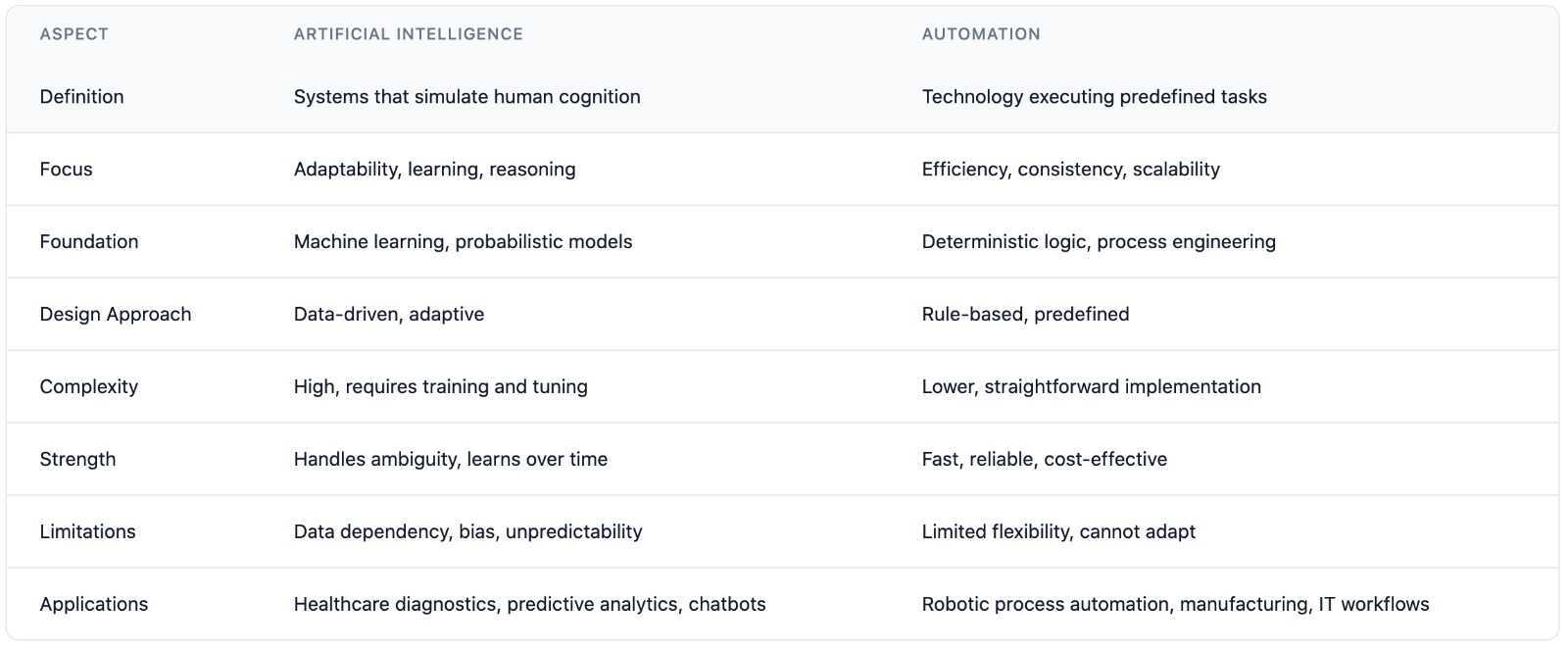
Comparison Table: AI vs Automation
Why Does It Matter?
So, why do these differences matter? When both can help businesses with productivity and efficiency, why do we care if it is through automation or AI?
The key answer to that is risk and investment.
Automation is a fairly simple process, and although the automations themselves can have several steps and branches, they are usually operated by a simple trigger. So the worst outcome is that the automation didn’t work when it was supposed to, or vice versa. Embarrassing, possibly (who hasn’t had an ‘oops’ email from one brand or another), but unlikely to cause serious harm.
Similarly, automations are relatively simple to set up. While it may be complicated to map out and implement, the skills and experience needed can be developed on the job. A bit of trial and error is expected, which is why testing is built into automated workflows.
Conversely, AI can come with a much higher investment of time, money, and expectations. The prompts need to be carefully crafted if they are to deliver the output you want, and it is easy to get them wrong. Training is essential.
In addition, the risks of something going wrong with AI are higher. As it is involved in understanding, analyzing, and summarizing, people rely on that information being accurate, but there is a real risk that it may not be. It’s not that AI deliberately misunderstands, but it has the potential to invent information that it feels is lacking. On top of this, is the well-known risk that AI draws information from sources that it does not have a copyright agreement to use. Both of these risks, when combined with the increased cost and time of implementation, should give organizations pause before they introduce it into their processes.
Before introducing automations or AI to your workflows, consider the goals of what you are hoping to achieve, the investment you’re willing to make, and the outcome you expect. This will help you determine which approach works best for you.
Practical Applications
1. Artificial Intelligence (AI)
Healthcare Diagnostics
AI is revolutionizing healthcare by enabling systems that can analyze medical images, patient histories, and genetic data with remarkable precision. For example, deep learning models trained on millions of radiology scans can detect early signs of cancer or cardiovascular disease that might be missed by human eyes. Beyond imaging, AI assists in predicting patient outcomes, recommending personalized treatment plans, and even identifying potential drug interactions. This not only improves accuracy but also reduces diagnostic time, allowing physicians to focus on patient care rather than repetitive analysis.
Fraud Detection in Finance
Financial institutions increasingly rely on AI to combat fraud, money laundering, and cybercrime. Unlike traditional rule-based systems, AI models can learn from vast transaction datasets, spotting subtle anomalies that indicate suspicious activity. For instance, machine learning algorithms can flag unusual spending patterns or detect synthetic identities used in credit fraud. The adaptability of AI ensures that fraud detection systems evolve alongside new criminal tactics, offering a dynamic shield against financial threats while reducing false positives that frustrate customers.
Conversational Agents in Customer Service
AI-powered chatbots and virtual assistants are transforming customer service by providing 24/7 support across industries. These systems leverage natural language processing (NLP) to understand customer queries, respond in real time, and escalate complex issues to human agents when necessary. Unlike static FAQ systems, modern AI agents can personalize interactions by remembering past conversations, predicting customer needs, and even upselling products. This not only enhances customer satisfaction but also reduces operational costs for businesses.
Autonomous Vehicles
Self-driving cars represent one of the most ambitious applications of AI. These vehicles rely on computer vision, sensor fusion, and reinforcement learning to interpret their environment, make split-second decisions, and navigate safely. AI enables cars to detect pedestrians, interpret traffic signals, and adapt to unpredictable road conditions. Beyond personal transport, autonomous systems are being deployed in logistics, where driverless trucks and drones promise to reduce delivery times and costs. The societal implications are vast, ranging from improved road safety to reshaping urban infrastructure.
2. Automation
Manufacturing Robotics
Automation has long been a cornerstone of manufacturing, with robotic arms assembling products at speeds and precision levels unattainable by humans. Modern automation systems integrate sensors and programmable logic controllers to ensure consistent quality and efficiency. In industries like automotive and electronics, robots handle welding, painting, and assembly, reducing human exposure to hazardous environments. The result is streamlined production lines capable of scaling output without sacrificing reliability.
Invoice Processing and Payroll
Back-office operations benefit immensely from automation, particularly in finance and HR. Robotic Process Automation (RPA) tools can extract data from invoices, validate entries, and process payments without human intervention. Similarly, payroll systems can automatically calculate salaries, deductions, and benefits, ensuring compliance with tax regulations. This reduces administrative overhead, minimizes human error, and frees employees to focus on strategic tasks rather than repetitive clerical work.
IT Operations (Backups, Monitoring)
Automation in IT ensures system reliability by handling routine tasks such as data backups, server monitoring, and patch management. Automated scripts can detect anomalies in network traffic, trigger alerts, and even initiate corrective actions before issues escalate. This proactive approach reduces downtime, enhances cybersecurity, and allows IT teams to focus on innovation rather than firefighting. In cloud environments, automation also enables dynamic resource allocation, ensuring optimal performance and cost efficiency.
Retail Inventory Management
Retailers leverage automation to track stock levels, forecast demand, and manage supply chains. Automated systems can update inventory in real time, reducing the risk of stockouts or overstocking. For example, sensors and RFID tags provide visibility into product movement, while algorithms predict seasonal demand fluctuations. This ensures shelves are stocked with the right products at the right time, improving customer satisfaction and reducing waste. In e-commerce, automation extends to order fulfillment, where robotic systems pick, pack, and ship items with speed and accuracy.
Artificial Intelligence (AI) – Pros & Cons
1. Pros
Learns and improves over time
One of AI’s most powerful traits is its ability to continuously evolve. Unlike static systems, AI models refine their performance as they are exposed to new data, patterns, and feedback. For example, a fraud detection system becomes more accurate as it encounters diverse transaction types, learning to distinguish legitimate activities from malicious ones. This adaptability ensures that AI remains relevant in dynamic environments where conditions change rapidly.
Handles ambiguity and unstructured data
AI excels in situations where traditional automation would fail. It can process messy, incomplete, or unstructured data, such as free-form text, images, or audio and still generate meaningful insights. For instance, natural language processing allows AI to interpret customer complaints written in different tones and styles, while computer vision can analyze medical scans with varying quality. This ability to handle ambiguity makes AI indispensable in complex, real-world scenarios.
Provides intelligent insights and predictions
Beyond task execution, AI offers predictive power. By analyzing historical data and identifying hidden correlations, AI can forecast future outcomes, such as predicting equipment failures in manufacturing or anticipating customer churn in retail. These insights empower organizations to make proactive decisions, reduce risks, and uncover opportunities that would otherwise remain invisible.
2. Cons
Requires large datasets and computing resources
Training and deploying AI systems often demand enormous amounts of data and computational power. High-performance GPUs, cloud infrastructure, and specialized hardware are frequently necessary, making AI costly to implement at scale. Small organizations may struggle to access the resources required to build competitive AI solutions.
Can introduce unpredictability
Unlike automation, which follows deterministic rules, AI can sometimes produce unexpected or inconsistent outputs. A chatbot may misinterpret a customer’s intent, or a predictive model may fail when faced with data outside its training distribution. This unpredictability can undermine trust, especially in high-stakes domains like healthcare or finance.
Often a “black box” – difficult to interpret decisions
Many AI models, particularly deep learning systems, operate as opaque black boxes. They deliver outputs without clear explanations of how those outputs were derived. For example, a loan approval algorithm may reject an applicant without providing transparent reasoning. This lack of interpretability raises ethical and regulatory concerns, especially in industries where accountability is critical.
Automation – Pros & Cons
1. Pros
Easy to implement with clear rules
Automation systems are straightforward to design and deploy because they rely on explicit instructions. A payroll automation tool, for instance, can be programmed to calculate salaries based on predefined formulas. This simplicity lowers the barrier to adoption, allowing organizations to quickly reap efficiency gains without complex infrastructure.
Highly reliable and predictable
Once rules are established, automation executes tasks consistently and without deviation. This reliability is particularly valuable in industries like manufacturing, where precision and repeatability are essential. Automated systems ensure that every product is assembled to the same standard, reducing defects and maintaining quality.
Reduces manual workload quickly
Automation shines in eliminating repetitive, time-consuming tasks. From processing invoices to scheduling system backups, automation frees human workers from mundane activities, enabling them to focus on strategic, creative, or customer-facing responsibilities. This shift not only boosts productivity but also enhances employee satisfaction.
2. Cons
Lacks flexibility
Automation is rigid by design. It cannot adapt to new or unforeseen circumstances without human intervention. For example, if an invoice arrives in an unexpected format, an automated system may fail to process it correctly. This lack of flexibility limits automation’s usefulness in dynamic or unpredictable environments.
Cannot handle exceptions or novel situations
When faced with scenarios outside its programmed rules, automation often breaks down. Unlike AI, which can infer or improvise, automation requires explicit instructions for every possible case. This makes it unsuitable for tasks involving creativity, judgment, or nuanced decision-making.
Maintenance becomes difficult as complexity grows
As organizations expand their automation systems, maintaining them becomes increasingly challenging. Each new rule or workflow adds complexity, and over time, the system can become fragile and prone to errors. Updating or debugging large-scale automation frameworks requires significant effort, often offsetting the initial efficiency gains.
Conclusion
Artificial Intelligence and Automation are distinct yet complementary technologies that, when strategically combined, can transform how organizations operate; automation excels at streamlining repetitive, rule-based tasks with speed, reliability, and scalability, while AI brings adaptability, intelligence, and the ability to learn from complex, unstructured data to deliver insights and predictions; businesses that understand these differences can deploy automation to stabilize routine processes and leverage AI to innovate, personalize, and respond to dynamic challenges, ultimately achieving workflows that are not only efficient but also intelligent, resilient, and aligned with long-term goals.
Authors




Combine Intelligence with Execution
Walturn helps organizations integrate AI and automation into scalable, production-ready systems. From Flutter apps to advanced AI workflows powered by Steve, we engineer intelligent products end-to-end.
References
Georgiev, M. (2025, September 5). Automation vs AI: What’s the Difference and Why Does it Matter. Automation vs AI: What’s the Difference and Why Does it Matter. https://www.vable.com/blog/automation-vs-ai-whats-the-difference-and-why-does-it-matter
Georgiev, M. (2025, September 5). Automation vs AI: What’s the Difference and Why Does it Matter. Automation vs AI: What’s the Difference and Why Does it Matter. https://www.vable.com/blog/automation-vs-ai-whats-the-difference-and-why-does-it-matter
Coulter, D., & Coulter, D. (2025, June 7). AI vs Automation: What’s the Difference, and When Should You Use Each? Daniel Coulter. https://danielcoulter.com/posts/ai-vs-automation-whats-the-difference-and-when-should-you-use-each
GeeksforGeeks. (2025c, July 23). What is Artificial Intelligence (AI) Automation? GeeksforGeeks. https://www.geeksforgeeks.org/blogs/artificial-intelligence-ai-automation/
Eastgate. “Automation vs AI: Key Differences & Best Uses Explained.” Medium, 27 Sept. 2023, https://medium.com/@eastgate/automation-vs-ai-key-differences-best-uses-explained-cc2989047329