AI Adoption in the Middle East: Faster Than Europe?

Summary
The article compares AI adoption in the GCC and Europe, highlighting how Gulf nations like UAE and Saudi Arabia have accelerated deployment through sovereign wealth, top-down execution, and strategic urgency. In contrast, Europe’s regulatory-first approach ensures safety but slows adoption. The Gulf’s model enables faster enterprise integration, infrastructure growth, and large-scale AI deployment.
Key insights:
Sovereign-Led Acceleration: Gulf governments act as investors, regulators, and adopters, compressing deployment cycles.
Capital Advantage: Trillions in sovereign wealth fund large-scale AI infrastructure and innovation.
Regulation vs Speed: Europe prioritizes governance, while the Gulf emphasizes rapid execution.
Enterprise Maturity Gap: GCC nations are moving from pilots to production faster than Europe.
Strategic Urgency: AI adoption is driven by economic diversification beyond oil.
Global Competitive Shift: The Gulf is emerging as a leading hub for AI infrastructure and talent.
Introduction
In 2017, the United Arab Emirates became the first sovereign state to appoint a Minister of State for Artificial Intelligence. Less than a decade later, that decision signals a region-wide transformation. The Gulf Cooperation Council (GCC), anchored by the UAE, Saudi Arabia, Qatar, and Kuwait, has emerged as one of the most consequential theatres of AI adoption globally, outpacing the European Union on several measurable indicators.
This trajectory reflects sovereign wealth of exceptional scale, the imperative to diversify away from hydrocarbon dependence, and Gulf governments acting simultaneously as AI strategists, anchor investors, and first adopters. The result contrasts sharply with Europe's governance-led approach, shaped by the EU AI Act of 2024. Both are coherent strategic choices; they have, however, produced a measurable divergence in enterprise AI deployment rates.
This Insight profiles the four focal GCC nations, analyses the forces behind their acceleration, and draws out implications for enterprise strategy across both geographies.
What "AI Adoption" Means Here
Artificial intelligence adoption, in the enterprise context, refers to the active integration of AI technologies, including machine learning, natural language processing, computer vision, and generative AI, into core business functions such as operations, customer engagement, finance, logistics, and public service delivery. Adoption is measured along a maturity continuum: from isolated pilots to enterprise-wide, production-grade deployment.
This distinction matters because aggregate adoption statistics can obscure critical differences. A country where 80% of firms have experimented with AI chatbots differs fundamentally from one where sovereign entities are deploying hundred-billion-parameter large language models in energy and government operations, as is already the case in Saudi Arabia. The Gulf, in particular, has accelerated from the experimental phase to active deployment at a pace that has drawn the attention of global technology strategists.
The Europe Benchmark: A Deliberate but Slower Pace
To contextualise the Gulf's trajectory, it is instructive to first understand where Europe stands. According to Eurostat data cited by the European Commission, 13.5% of EU enterprises actively used AI technologies as of 2024, up from 8% in 2023. Among large enterprises (250+ employees), that figure rises to approximately 41%. Even so, fewer than half of Europe's largest companies have moved beyond pilot or exploratory phases.
Europe's relative caution is not the result of technological incapacity; the continent leads in regulatory infrastructure. The EU AI Act of 2024, the world's first comprehensive AI law, established harmonised rules prioritising responsible development, data privacy, and human oversight. The subsequent AI Continent Action Plan (April 2025) outlined ambitions for large-scale "AI gigafactories" to close the infrastructure gap. Yet the compliance burden inherent in this regulatory architecture has, for many enterprises, created a deliberate brake on speed-to-deployment, particularly for small and medium-sized enterprises.
The result is a continent characterised by strong foundations and responsible intent, but constrained deployment velocity. By contrast, Gulf governments, functioning simultaneously as sovereign investors, regulators, and first adopters of AI, have been able to compress the cycle from strategy to deployment.
Country Profiles: The Gulf's AI Leaders
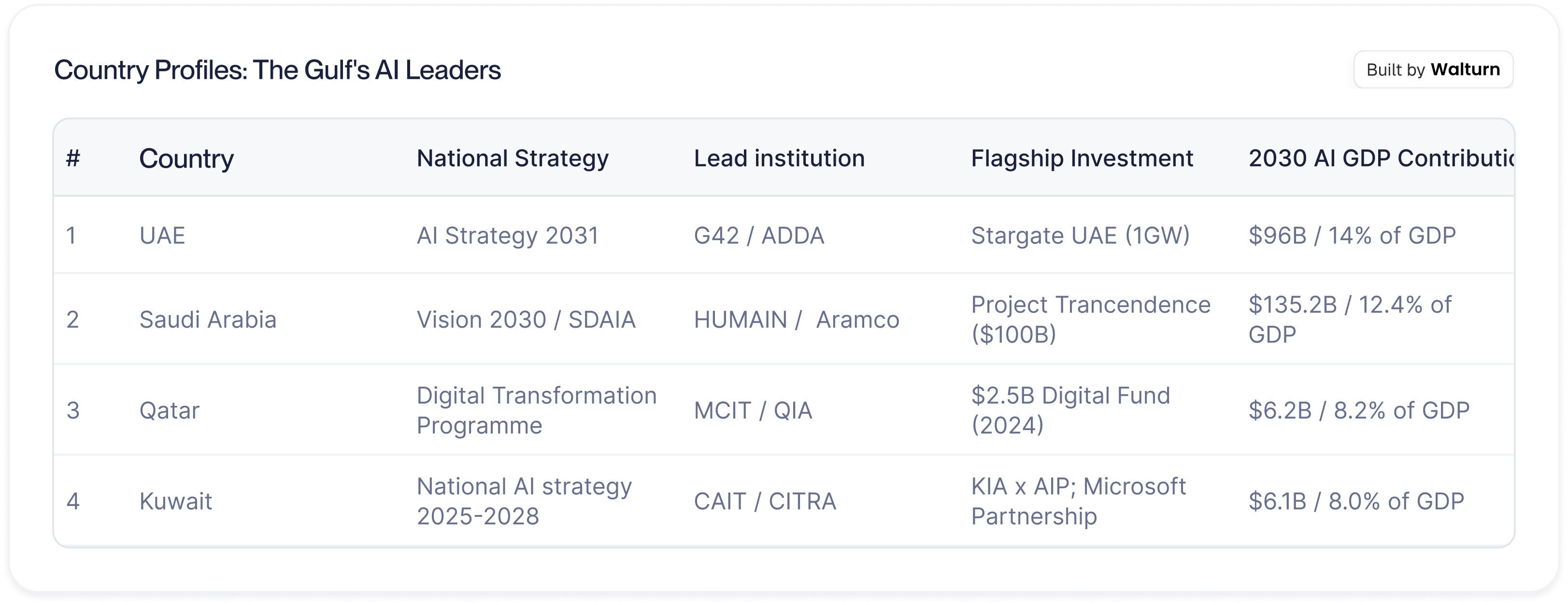
1. United Arab Emirates: First Mover Advantage
The UAE has the strongest claim to being the world's most AI-forward nation on a per-capita basis. In 2017, it became the first country to appoint a Minister of State for Artificial Intelligence, H.E. Omar Sultan Al Olama. It launched a National AI Strategy that has since been updated as the UAE National AI Strategy 2031, explicitly targeting the UAE's position as a global AI leader. Population-level AI usage in the UAE stands at 64%, the highest globally according to AI adoption indices.
On the infrastructure front, the UAE's state-backed firm G42, supported by sovereign investment vehicle Mubadala, is at the centre of an ambitious data centre cluster. In May 2025, the White House confirmed a deal allowing the UAE access to hundreds of thousands of advanced semiconductors for an AI campus in Abu Dhabi, forming part of the "US-UAE AI Acceleration Partnership." OpenAI simultaneously reached an agreement to provide nationwide ChatGPT Plus access to all UAE residents, making the Emirates among the first nations globally to enable such country-wide access.
The UAE also launched "Stargate UAE" in May 2025: a 1-gigawatt AI data centre project, supported by OpenAI, NVIDIA, and Oracle. For context, the UAE's existing data centre capacity of 300MW is already growing toward a 1GW target, a scale that dwarfs the infrastructure commitments of most European individual states.
2. Saudi Arabia: Scale, Vision, and Sovereign Firepower
Saudi Arabia brings unmatched scale to the GCC's AI ambitions. Under Crown Prince Mohammed bin Salman's Vision 2030, officials have noted that 70% of Saudi strategic goals involve data and AI. The Saudi Data & AI Authority (SDAIA), established to coordinate national AI policy, has been accompanied by a cascade of investments that collectively represent the most aggressive national AI build-out in the world outside of the United States and China.
In late 2024, Saudi Arabia announced "Project Transcendence", a $100 billion AI initiative, and in 2024 had already earmarked a $40 billion fund for AI investments, including semiconductor manufacturers and data centres. At the LEAP 2025 conference (February 2025), the Kingdom unveiled over $14.9 billion in new AI and digital infrastructure commitments, including a $1.5 billion inference data centre in collaboration with Groq and Aramco Digital.
Saudi Aramco exemplifies enterprise-level AI sophistication: the company built a 250-billion-parameter generative AI model from decades of operational data to analyse drilling plans, geological information, and cost optimisation. This is among the largest industry-specific LLMs in existence. Google Cloud and the Public Investment Fund (PIF) announced a $10 billion partnership to build a global AI hub in Saudi Arabia through HUMAIN, a PIF-backed AI company established in 2025.
3. Qatar: Focused Investment and Global Alignment
Qatar's AI trajectory is characterised by strategic focus rather than sheer scale. In May 2024, the Qatari government earmarked $2.5 billion to accelerate its digital transformation programme. That same year, Qatar signed a five-year partnership with US firm Scale AI to drive AI adoption within government and enhance public services, a move that underscores Doha's preference for targeted, high-impact international partnerships over broad-spectrum investment.
Qatar also participates actively in global AI governance: the country engaged in the Global Forum on AI Safety in South Korea (May 2024), and its delegation joined high-level discussions with major technology companies on the future of AI governance frameworks. Qatar's national AI market value is projected to grow significantly through 2030, supported by its substantial sovereign wealth fund, the Qatar Investment Authority (QIA), which has invested in AI ventures, including xAI (Elon Musk's AI company).
4. Kuwait: The Emerging Contender
Kuwait is widely regarded as a late-stage entrant to the Gulf AI race, but recent developments suggest it is closing the gap with notable momentum. The country formally launched the draft Kuwait National AI Strategy (2025–2028), a framework aligned with Kuwait Vision 2035, setting out a three-year roadmap to embed AI across healthcare, logistics, education, and public administration.
In March 2025, the Central Agency for Information Technology (CAIT) and the Communications and Information Technology Regulatory Authority (CITRA) formalised a strategic partnership with Microsoft to deploy AI data centres and roll out Microsoft 365 Copilot across government institutions. Kuwait became one of the first nations in the region to implement Copilot for Microsoft 365 at a government-wide scale.
Critically, in June 2025, the Kuwait Investment Authority (KIA) joined the AI Infrastructure Partnership (AIP), an initiative co-anchored by MGX, BlackRock, Global Infrastructure Partners, and Microsoft, signalling that Kuwait's sovereign wealth fund is now directly channelling capital into next-generation AI infrastructure. Kuwait's private sector also shows notable AI readiness: 62% of Kuwaiti organisations report AI as a top business priority, and over 68% of multinationals operating in Kuwait believe AI will provide a significant competitive advantage.
Why Gulf AI Is Moving Faster Than Europe
Several structural factors account for the velocity differential:
Government as first adopter and co-investor: Gulf governments are not passive regulators of AI; they are anchor customers, sovereign investors, and strategic deployers simultaneously. This compression of roles dramatically shortens the cycle from policy to deployment.
Sovereign wealth as patient capital: The GCC collectively holds over $3 trillion in sovereign wealth fund assets. These funds have been mobilised for long-horizon AI infrastructure investments that private markets would typically not undertake at such speed or scale.
Oil diversification imperative: The existential pressure to reduce hydrocarbon dependency has given AI adoption a strategic urgency in the Gulf that is simply absent in Europe's established, diversified economies. AI is not merely a productivity tool in the Gulf; it is an economic survival strategy.
Lean regulatory architecture (so far): Unlike Europe's comprehensive AI Act, Gulf AI regulation remains principally enabling in orientation. While this creates future risks around AI ethics and data governance, it has lowered deployment friction in the near term.
Top-down speed of execution: Decisions that require years of multi-stakeholder deliberation in Europe can be executed within months at the Gulf's head-of-state level. The UAE's nationwide ChatGPT Plus agreement, for example, was announced and implemented in a matter of weeks.
Implications for Enterprise Strategy
For organisations considering Middle East expansion or AI capability development, the Gulf's trajectory carries direct strategic implications. First, the region is no longer a pilot market or an emerging frontier; it is an active, competitive arena for enterprise AI deployment, with some of the world's most sophisticated AI consumers already in production at scale. Companies seeking to sell, deploy, or partner in the region should calibrate their offerings accordingly.
Second, the talent calculus in the Gulf is shifting. World-class AI research and education are being built outside traditional Western hubs, supported by government-funded universities and research centres across Abu Dhabi, Riyadh, and Doha. Organisations seeking AI talent should engage with Gulf academic and research ecosystems proactively, rather than treating the region primarily as a consumer of externally produced AI.
Third, the regulatory divergence between Europe and the Gulf creates distinct operating environments. Enterprises operating across both geographies must manage the complexity of Europe's compliance-oriented AI Act alongside the Gulf's more permissive, speed-prioritising frameworks, requiring a bifurcated but coherent governance posture.
Conclusion
The Gulf's AI adoption story is, at its core, a story about the relationship between political will, sovereign capital, and strategic execution. The UAE, Saudi Arabia, Qatar, and Kuwait have each, in their distinct ways, demonstrated that AI adoption can be accelerated dramatically when governments treat the technology as a national strategic priority rather than a market outcome. This acceleration is not merely transactional; it is increasingly grounded in a deepening indigenous AI ecosystem, from sovereign-funded research institutions to large-scale data infrastructure.
Europe's more measured pace reflects the trade-offs inherent in building robust governance before deploying at scale, a defensible choice with long-term merits. But in the near term, the evidence is clear: on the metrics that matter most, investment magnitude, enterprise deployment rates, infrastructure ambition, and speed of execution, the Gulf is not merely keeping pace with Europe. In several respects, it has already moved ahead.
Authors




Build AI at Gulf Speed
Walturn partners with Middle Eastern SMBs to design, deploy, and scale AI systems aligned with rapid execution and national ambitions.
References
PricewaterhouseCoopers. (n.d.). The potential impact of Artificial Intelligence in the Middle East - PwC Middle East. PwC. https://www.pwc.com/m1/en/publications/potential-impact-artificial-intelligence-middle-east.html
Bricks, D. (2025, August 1). The state of AI in the Middle East (2025). Digital Bricks. https://www.digitalbricks.ai/blog-posts/the-state-of-ai-in-the-middle-east-2025
The Middle East’s big bet on artificial intelligence and data security. (2025, September 24). Crowell & Moring - the Middle East’s Big Bet on Artificial Intelligence and Data Security. https://www.crowell.com/en/insights/client-alerts/the-middle-easts-big-bet-on-artificial-intelligence-and-data-security
Tilawat, M. (2026, March 17). Global AI Adoption Rate by Country 2026: Statistics, Rankings & Forecasts. All About AI. https://www.allaboutai.com/resources/ai-statistics/global-ai-adoption/
Cook, S. A. (2026, February 24). For the Gulf States, Investment in AI Is Partly About U.S. Protection. Foreign Policy. https://foreignpolicy.com/2026/02/23/gulf-states-investment-ai-american-protection-qatar-uae-saudi/