Internal AI Tools vs. Public AI Tools: What Is Safer?

Summary
AI safety in the enterprise is not a binary choice between internal and public tools but a question of governance, data exposure, and regulatory fit. Public AI tools offer speed, accessibility, and lower upfront cost, while internal AI systems provide stronger control, customization, and auditability. For most organizations, the safest approach is a hybrid model that matches deployment type to workload risk and compliance requirements.
Key insights:
Public AI Tradeoff: Public AI tools enable fast adoption and broad utility but increase exposure to external processing and governance gaps.
Internal AI Control: Internal AI systems keep proprietary data within private infrastructure and allow tighter security, access, and compliance controls.
Shadow AI Risk: Unsanctioned employee use of consumer AI tools creates blind spots that can expose sensitive data without IT oversight.
Compliance Pressure: Regulations such as GDPR, HIPAA, CCPA, and the EU AI Act make AI governance and traceability increasingly critical.
Enterprise Tiers Matter: Enterprise-grade public AI tools offer stronger safeguards than consumer versions, but they still may not fit sensitive workflows.
Hybrid Strategy Wins: The most practical model uses public AI for low-risk tasks and internal AI for regulated or mission-critical use cases.
Introduction
Artificial intelligence has shifted from an experimental capability to a core component of enterprise operations, with marketing teams using it for campaign development, engineers for debugging code, and finance divisions for modelling. McKinsey reports that half of all companies now deploy AI across at least two business functions, up from fewer than one-third in 2023.
As adoption accelerates, IT leaders and executives face a critical question: which AI deployment model is secure enough for enterprise use? Two approaches dominate: public AI tools such as ChatGPT, Gemini, and Microsoft Copilot, which deliver broad, general-purpose intelligence quickly, and internal AI tools, custom-built or privately deployed models fine-tuned on proprietary data, which provide precision and governance at greater cost. This insight explores both models, their differences in security and data privacy, the regulatory landscape, and a framework for organizational decision-making.
Definitions
1. Public AI Tools
Public AI tools are artificial intelligence systems made broadly accessible via the internet, typically through a web-based interface, mobile application, or application programming interface (API). These systems are trained on large-scale public datasets and operate entirely on the infrastructure of the service provider, with prominent examples including ChatGPT by OpenAI, a conversational language model used for writing, coding, analysis, and Q&A; Gemini by Google DeepMind, a multimodal AI integrated into Google Workspace; and Microsoft Copilot, an AI assistant embedded in Office 365 and developer tools.
These tools are designed for general-purpose applications across a broad range of industries and tasks. Their principal appeal lies in accessibility: relatively low cost, minimal configuration requirements, and continuous model improvement driven by a large global user base.
2. Internal AI Tools
Internal AI tools are artificial intelligence systems purpose-built to serve the specific operational needs of a particular organization. They are deployed on-premises or within a private or hybrid cloud environment and are trained or fine-tuned exclusively on proprietary, organization-owned datasets. Representative examples include a hospital deploying a clinical decision-support model on its own infrastructure to comply with HIPAA, a law firm running a private LLM fine-tuned on its case archives that remain inaccessible to third parties, and a financial institution using a Retrieval-Augmented Generation (RAG) system connected to internal risk data.
Internal AI tools prioritize governance, control, and customization. They are configured in accordance with internal data policies, applicable regulatory requirements, and the organization's proprietary knowledge base.
3. Shadow AI
Shadow AI refers to the unsanctioned deployment or usage of AI tools by individual employees or organizational units, without the knowledge, oversight, or approval of information technology or security governance functions. It represents the AI-specific equivalent of shadow IT, and it poses a particularly acute organizational risk: employees using personal accounts on free, consumer-grade AI platforms may inadvertently expose sensitive corporate data to external systems. Research conducted in 2024 found that nearly 40% of workers share sensitive organizational information with AI tools without their employer's awareness.
The Risk Landscape: What's Actually at Stake?
A rigorous assessment of the security implications associated with AI tool deployment requires careful examination of the specific threat vectors introduced by each deployment model. The risks involved are not hypothetical constructs; they are documented incidents that have already materialized across organizations globally.
1. Data Leakage and Training Exposure
With public AI, user inputs may be retained by the service provider and subsequently used to train or refine future models. For free and lower-tier accounts on platforms such as ChatGPT, conversation history is stored indefinitely unless the user explicitly deletes it. The Samsung incident of 2023 serves as a salient illustration where employees uploaded proprietary source code and confidential internal meeting notes to ChatGPT, effectively disclosing trade secrets to an external, third-party system. Samsung subsequently prohibited the use of all external AI tools across its global operations.
The scale of this risk has expanded considerably. In 2025, sensitive data was found to constitute 34.8% of employee ChatGPT inputs, an increase of nearly threefold from 11% recorded in 2023. In the majority of cases, such inputs are well-intentioned: employees seeking to improve their operational efficiency rather than to disclose confidential information. Nevertheless, the structural architecture of consumer-grade AI tools creates a condition of persistent, systemic exposure.
2. Credential Theft and Account Compromise
In 2025, security researchers identified over 225,000 OpenAI and ChatGPT account credentials available for purchase on dark web marketplaces, harvested through infostealer malware. These incidents did not constitute direct breaches of OpenAI's own infrastructure; rather, threat actors compromised individual employee devices to extract login credentials, subsequently accessing complete conversation histories that in many cases contained sensitive business data. This pattern represents an emergent class of attack that combines traditional credential theft with exposure of AI-specific information.
3. Prompt Injection and Adversarial Attacks
The attack surfaces introduced by AI systems extend well beyond those addressed by traditional cybersecurity frameworks. The EchoLeak vulnerability (CVE-2025-32711), identified in Microsoft 365 Copilot, demonstrated a zero-click prompt-injection attack that used sophisticated Unicode character substitutions to circumvent the platform's safety filters. Researchers established that a maliciously crafted email could cause the AI assistant to exfiltrate sensitive business data to an external URL, without any visible interaction from the affected user.
According to Stanford HAI's 2025 AI Index Report, publicly reported AI-related security and privacy incidents increased by 56.4% between 2023 and 2024. The threat landscape, by any objective measure, remains highly dynamic.
4. Shadow AI and Governance Blind Spots
Deloitte's 2025 analysis identified shadow AI as one of the most consequential internal AI risks facing enterprises. When individual teams deploy or utilize AI tools without centralized oversight, organizations forfeit visibility into the nature of data being processed, its destination, and its compliance status relative to internal governance policies and external regulatory obligations. According to Zylo's 2025 SaaS Management Index, 77% of IT leaders reported discovering AI-powered features or applications operating within their environments without prior IT awareness or authorization.
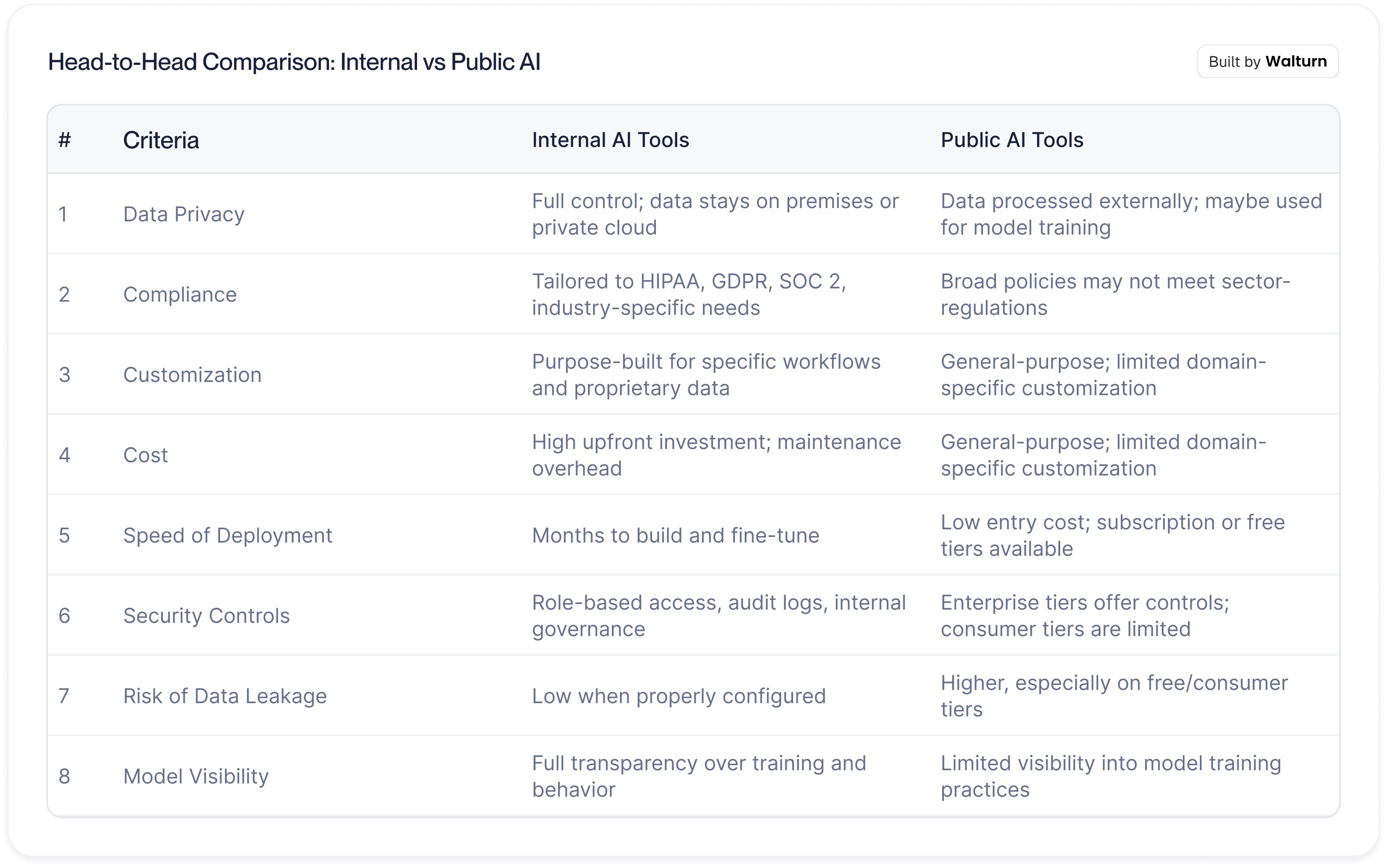
Head-to-Head Comparison: Internal vs Public AI
Compliance: The Regulatory Dimension
Regulatory pressure on artificial intelligence is intensifying at a considerable pace. United States federal agencies issued 59 AI-related regulations in 2024 alone, more than double the 25 issued in the preceding year. Globally, legislative references to AI increased by 21.3% across 75 countries. The inability to monitor, track, or govern AI usage creates immediate compliance exposure across all major regulatory frameworks.
1. Key Regulatory Frameworks
GDPR (EU): Requires documentation of all data processing activities. Every untracked AI interaction potentially constitutes a violation, with penalties up to 4% of global annual revenue.
HIPAA (US Healthcare): Limits how patient data can be used in AI tools. Healthcare organizations sharing patient information with free AI tools face potential fines and license risk.
CCPA (California): Mandates the ability to track and delete personal information upon request. Penalties range from $2,500 to $7,500 per violation.
EU AI Act: Fines for non-compliance can reach €35 million or 7% of global annual turnover for high-risk systems.
Notably, only 12% of organizations currently rank compliance violations among their foremost AI security concerns, a significant disconnect given the substantive regulatory exposure they face. Internally deployed AI tools, operating within a private and fully auditable infrastructure, are considerably better positioned to satisfy these compliance obligations. The National Institute of Standards and Technology's AI Risk Management Framework (NIST AI RMF) is increasingly recognized as the benchmark standard for responsible AI governance, particularly within regulated industries.
The Case For Each Approach
1. When Public AI Tools Make Sense
Public AI tools are not categorically unsafe, and enterprise-grade deployments of platforms such as ChatGPT Enterprise, Microsoft Copilot for Microsoft 365, and Gemini for Google Workspace provide materially stronger data protections than their consumer-facing counterparts, including contractual commitments against training on customer data, SOC 2 Type II compliance attestation, single sign-on (SSO) integration, centralized administrative dashboards, and data loss prevention controls. These platforms are well-suited to lower-risk, non-regulated workflows such as marketing drafts, brainstorming, and general productivity tasks; organizations that need rapid AI deployment without infrastructure investment; small to mid-sized businesses without the resources to build and maintain internal models; and general knowledge tasks where proprietary data is not involved.
2. When Internal AI Tools Are the Right Choice
Internally deployed AI tools are purpose-built for operational contexts in which data sensitivity, regulatory compliance, and domain-specific precision are non-negotiable organizational requirements. They are the appropriate deployment choice for healthcare, finance, legal, and government organizations handling regulated data; companies with substantial proprietary knowledge that must remain within the organization; workflows requiring tight integration with internal systems such as CRM, ERP, and internal knowledge bases; and organizations that require full auditability, model transparency, and access control.
The fundamental differentiator, however, lies in the treatment of proprietary data. Every organization possesses its own institutional language, domain-specific datasets, and accumulated internal knowledge. When AI systems are trained or fine-tuned using that proprietary information, they acquire a contextual depth and operational specificity that no general-purpose public model can replicate, while ensuring that organizational knowledge remains protected and within the organization's control.
3. The Hybrid Strategy: Aligning Deployment to Risk
For the majority of enterprises, the governing question is not simply whether to adopt internal or public AI, but rather how to construct a coherent, risk-informed strategy that deploys each model in the context most appropriate to it. Gartner and other leading technology research institutions increasingly advocate for a hybrid deployment approach: utilizing public AI platforms for general productivity enhancements and lower-risk operational tasks, whilst reserving private AI infrastructure for sensitive, regulated, or mission-critical workloads.
Microsoft's enterprise security guidance reinforces this framework through a Zero Trust architectural approach: analogous to human users, AI agents require continuous protection through observability, governance controls, and robust security measures. Organizations that succeed in the next phase of enterprise AI adoption will be those that combine operational velocity with the deliberate alignment of business, information technology, security, and development functions to govern and secure their AI transformation programmes.
Conclusion
The question of whether internally deployed or publicly accessible AI tools are safer does not have a single answer; it depends on context. Both models carry risks and deliver organizational value, but the key distinction lies in who controls the risk and whether that governance is appropriate given the sensitivity and regulatory classification of the data. Public AI tools, even in enterprise-grade deployments, are sufficient for many workflows, yet they are not universally appropriate; for regulated industries, sensitive data, or proprietary intellectual property, their architecture introduces systemic risks that contractual safeguards cannot fully eliminate. Internally deployed AI tools require greater investment, longer timelines, and technical expertise, but they provide assurances no public platform can match: complete organizational sovereignty over data, model behavior, and risk management. The most effective organizations in 2026 will avoid treating this as a binary choice, instead adopting a disciplined, risk-calibrated hybrid strategy that aligns deployment models with data sensitivity, regulatory obligations, and organizational risk tolerance.
Authors




Build a Safer Enterprise AI Strategy
Walturn helps organizations design AI systems and governance models that align security, compliance, and product needs. From private deployments to hybrid AI workflows, Walturn turns AI adoption into a controlled business advantage.
References
The top AI security risks facing enterprises in 2025. (2025c, November 5). https://www.obsidiansecurity.com/blog/ai-security-risks
Zylo, & Zylo. (2026, February 19). The dark side of AI: top data security threats and how to prevent them. Zylo. https://zylo.com/blog/ai-data-security/
Industry News 2024: AI security risk and best practices. (n.d.). ISACA. https://www.isaca.org/resources/news-and-trends/industry-news/2024/ai-security-risk-and-best-practices
The AI advantage dilemma: Security risks and opportunities that lie ahead. (2026, February 9). Deloitte Insights. https://www.deloitte.com/us/en/insights/topics/technology-management/tech-trends/2026/using-ai-in-cybersecurity.html
AI21 Labs. (2025, December 16). Private AI vs. Public AI: What is the Difference? | AI21. AI21. https://www.ai21.com/knowledge/private-ai-vs-public-ai/
ChatGPT vs. Custom AI Models: What’s the Right Approach for Your Business? — Marvik. (n.d.). https://www.marvik.ai/blog/chatgpt-vs-custom-ai-models-whats-the-right-approach-for-your-business
Staff, S., & Staff, S. (2023, August 21). Determining Which Generative AI Approach is Right for Your Marketing Team: Public vs. Proprietary vs. Enterprise Tools. Skyword. https://www.skyword.com/contentstandard/generative-ai-tools-public-vs-private-vs-enterprise/