AI for Finance Teams: Forecasting, Reconciliation, and Risk

Summary
AI is transforming finance from a retrospective reporting function into a forward-looking decision engine. By automating forecasting, reconciliation, and risk monitoring, AI enables finance teams to analyze large datasets, detect anomalies, and model scenarios in real time. This shift improves forecasting accuracy, accelerates transaction matching, strengthens fraud detection, and provides continuous visibility into financial risks and liquidity.
Key insights:
Continuous Forecasting: AI replaces static spreadsheet models with adaptive forecasts that update continuously as new data becomes available.
Automated Reconciliation: AI interprets structured and unstructured transaction data to match records across systems, reducing manual work and errors.
Real-Time Risk Monitoring: Machine learning detects anomalies, fraud patterns, and credit risks early by analyzing behavioral and transactional signals.
Scenario Simulation: AI can rapidly test multiple financial scenarios, helping finance teams plan for volatility and make faster strategic decisions.
Improved Cash Visibility: Continuous reconciliation provides real-time insights into cash positions, payments in transit, and liquidity exposure.
Strategic Role of Finance: Automation of operational tasks allows finance teams to focus on analysis, planning, and guiding organizational decisions.
Introduction
For decades, finance teams have focused on explaining what has already happened, reporting performance, closing books, and managing risk through periodic reviews, but the expectations placed on them today are far greater. Modern finance leaders are now expected to anticipate disruption, guide strategic decisions, and protect the organization in an environment defined by constant volatility, yet many finance functions still rely on static forecasts, manual reconciliation processes, and backward-looking risk models built for a slower era. Artificial Intelligence is changing this paradigm by enabling continuous forecasting, intelligent reconciliation, and real-time risk sensing, transforming finance from a retrospective reporting function into a forward-looking decision engine that actively shapes growth, resilience, and competitive advantage.
The Core Shift
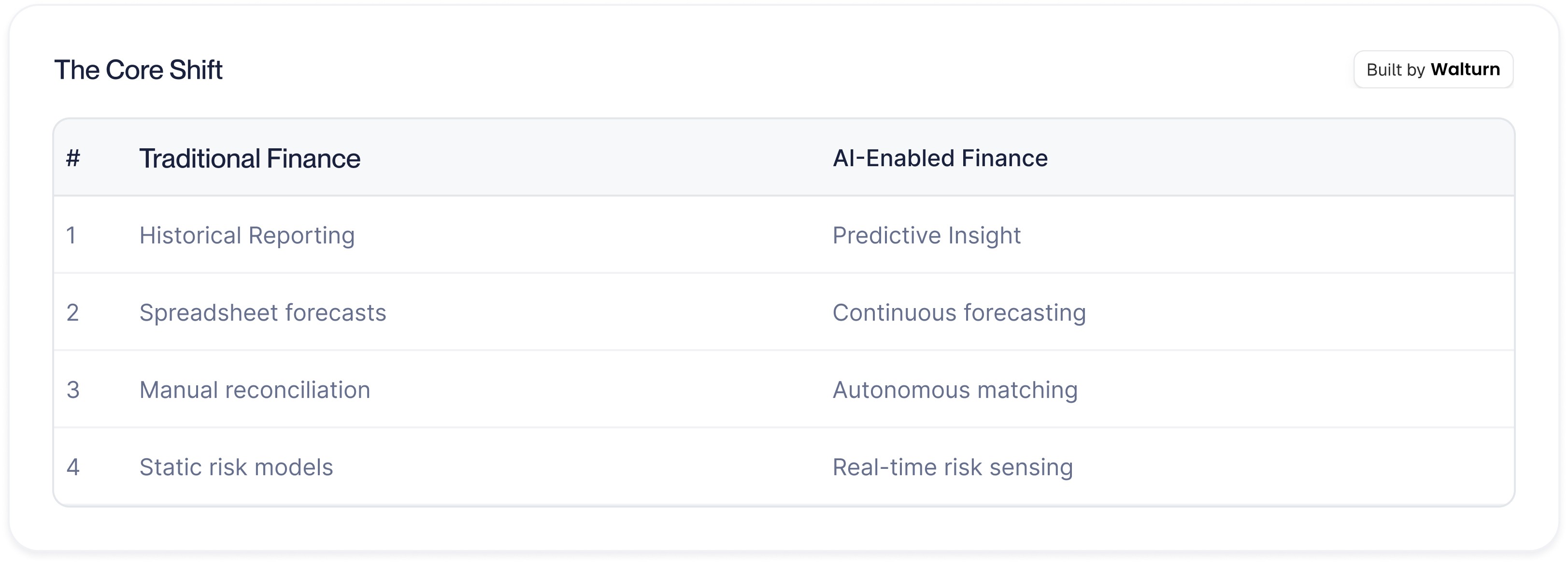
Traditional finance focuses on looking backward, relying on historical reports, spreadsheet-based forecasts, manual reconciliation, and static risk models to understand what has already happened. AI-enabled finance shifts the focus forward by generating predictive insights, enabling continuous forecasting, automating transaction matching, and sensing risks in real time. Instead of reacting to the past, finance teams can proactively anticipate trends, detect issues early, and support faster, smarter decision-making.
Forecasting
1. The Challenge with Traditional Forecasting
Financial forecasting has historically been a time-intensive and assumption-driven process. It depends on multiple manual inputs, spreadsheet models, and periodic updates that are often outdated by the time they are finalized. These models typically rely on limited datasets and struggle to account for shifting market conditions, seasonal patterns, or unexpected volatility. As a result, traditional forecasting is not only slow but also prone to human error and bias.
In fast-changing environments, this creates a critical limitation: forecasts become static snapshots of a dynamic reality.
2. How AI Transforms Forecasting
AI introduces a fundamentally different approach by enabling finance teams to fully leverage their data. Instead of relying on narrow datasets, it can analyze vast and diverse sources of information to identify seasonal trends, behavioral patterns, market shifts, and hidden correlations. This allows AI-powered models to generate forecasts that are significantly more accurate and grounded in real-world signals rather than assumptions.
Importantly, AI-driven forecasting is not fixed but adaptive. As new data becomes available, AI systems continuously learn and refine their predictions, allowing forecasts to evolve alongside changing business and market conditions.
3. From Prediction to Insight
Beyond pattern recognition, AI enhances forecasting by detecting anomalies and outliers early, identifying deviations from expected trends, and highlighting potential risks or opportunities as they begin to emerge. These capabilities allow finance teams to move past surface-level analysis and uncover meaningful signals within their data that might otherwise go unnoticed.
As a result, finance teams gain deeper visibility into what may be developing beneath the surface of their financial landscape. Rather than reacting after outcomes occur, they are better equipped to investigate early signals and make informed decisions sooner, improving both responsiveness and strategic foresight.
4. Faster Scenario Planning
AI also dramatically accelerates complex analyses and scenario modeling. Whereas traditional forecasting often requires significant manual effort to test different assumptions, AI can simulate multiple scenarios quickly, enabling finance teams to evaluate potential outcomes and understand the impact of changing variables in near real time.
This capability enhances strategic planning, improves budget alignment, and strengthens responsiveness to market volatility, giving finance teams the agility to make faster, more informed decisions in a dynamic business environment.
5. Shifting the Role of Finance
By automating repetitive data analysis and forecasting tasks, AI frees finance professionals from operational burdens, allowing them to redirect their focus toward strategic initiatives, higher-level planning, and supporting business decisions. Rather than spending time building and maintaining models, finance teams can concentrate on interpreting insights and guiding the organization forward, turning data into actionable intelligence that drives growth and resilience.
6. The Result
AI-driven forecasting enhances accuracy, efficiency, and adaptability by replacing static, assumption-based projections with dynamic, data-driven insights. In doing so, forecasting transforms from a periodic exercise into a continuously improving capability, empowering finance teams to anticipate change proactively rather than simply reacting to it.
Reconciliation
1. The Hidden Bottleneck in Finance
Reconciliation remains one of the most operationally intensive processes within finance. Teams routinely spend hours cross-referencing transactions across banks, payment processors, billing systems, and internal records, often working through inconsistent formats, missing references, and ambiguous transaction descriptions.
Before reconciliation can even begin, data frequently needs to be cleaned, mapped, and standardized. This manual effort introduces delays, increases the risk of errors, and limits scalability. As transaction volumes grow, reconciliation becomes not just a task, but a bottleneck.
2. How AI Changes the Reconciliation Process
AI fundamentally shifts reconciliation from a manual exercise to an intelligent, automated capability. Modern AI models, including Large Language Models (LLMs), can interpret both structured and unstructured financial data across multiple sources. This allows them to reconcile transactions at scale, even when records do not match perfectly.
Rather than depending on exact one-to-one matches, AI can interpret shorthand references, recognize variations in naming, connect related records across different systems, and resolve partial or fragmented data. For example, payments without invoice references, variations in payer names, or remittance details sent separately can still be accurately matched using contextual clues and historical patterns.
3. Streamlining Data Complexity
Finance teams often handle vast amounts of messy data from banks, payment providers, and internal systems, which traditionally requires extensive manual effort to clean and normalize before reconciliation can proceed. AI automates this foundational step by parsing free-text descriptions, standardizing inconsistent formats, mapping disparate fields into a unified structure, and flagging duplicates or anomalies. Importantly, this intelligence is applied without altering the source data, allowing reconciliation to progress smoothly without manual intervention.
4. Intelligent Matching and Adaptive Rules
Reconciliation typically relies on predefined rules to match transactions. Creating and maintaining these rules manually is labor-intensive and often dependent on institutional knowledge. AI improves this by learning from historical transaction behavior.
AI can recommend matching rules based on past patterns, identify attributes linked to successful matches, suggest refinements as transaction trends evolve, and learn from manual overrides to improve its performance over time. This reduces dependency on static logic and ensures reconciliation processes remain adaptive as business activity changes.
4. Scaling Across Complexity
As organizations grow, reconciliation becomes increasingly complex, particularly across multiple entities, currencies, or internal transfers. AI can match transactions across entities even when formats differ, names vary, or currencies fluctuate. It can also identify imbalances in intercompany flows and help maintain accurate internal balances continuously, not just at period-end.
5. Detecting Anomalies Early
Discrepancies are inevitable, whether caused by errors, unexpected fees, or fraudulent activity. AI continuously monitors reconciliation activity to detect anomalies, group related exceptions, and identify emerging issues. Instead of manually investigating mismatches, finance teams receive contextual insights that accelerate resolution and enhance transparency.
6. Real-Time Cash Visibility
One of the most significant advantages of AI-enabled reconciliation is the improved clarity it provides into cash positions. Payments may be initiated but not yet received, received but not applied, or delayed within processing systems. AI continuously reconciles incoming data to offer real-time visibility into cleared funds, payments in transit, and unapplied transactions. This enhanced transparency reduces uncertainty and supports more confident, timely financial decision-making.
7. From Manual Task to Strategic Capability
By automating data ingestion, transaction matching, anomaly detection, and reporting, AI significantly reduces the operational burden of reconciliation. Rather than spending time on repetitive processing, finance teams can focus on higher-value activities such as risk mitigation, strategic analysis, and financial optimization. This transformation not only accelerates reconciliation cycles but also creates a more agile and resilient finance function, capable of scaling efficiently without requiring proportional increases in headcount.
Risk
1. Credit Risk
AI is rapidly reshaping how organizations assess and manage credit risk across the entire credit lifecycle. Traditionally, credit evaluation has relied heavily on structured financial data and manual analysis, often limiting visibility into broader risk signals. Generative AI changes this by enabling financial institutions to analyze both structured and unstructured data, including documents, disclosures, customer interactions, and market signals, to build a more complete and dynamic understanding of borrower risk.
During underwriting and decision-making, AI can streamline the review of financial documents, identify missing or inconsistent information, and assist in compiling credit analyses and memos for review by credit officers. It can also extract insights, calculate ratios, and summarize risk factors in a fraction of the time required by manual processes. Beyond decision-making, AI supports ongoing portfolio monitoring by automating performance reporting and detecting early warning signals, even incorporating real-time external information such as news or market developments to identify emerging borrower risk.
The impact extends beyond efficiency. AI enables more consistent risk assessments, faster decision cycles, and more proactive portfolio management. While implementation requires careful governance around data quality, fairness, and transparency, organizations that successfully integrate AI into credit risk processes gain a significant advantage, shifting from periodic, reactive risk evaluation toward continuous, intelligence-driven risk monitoring.
2. Fraud
Fraud detection has traditionally relied on rigid, rules-based systems that struggle to keep pace with the scale and sophistication of modern financial crime. AI introduces a more adaptive approach by using machine learning to analyze vast volumes of transactional data and distinguish between legitimate behavior and suspicious activity. By learning from historical patterns, AI systems can identify subtle anomalies, such as unusual transaction types, locations, or behavioral changes, that may indicate fraud, even when these signals are too complex or faint for manual detection.
Unlike static systems, AI-powered fraud detection evolves over time. Through supervised learning, models become highly effective at recognizing known fraud patterns, while unsupervised techniques enable them to detect entirely new and previously unseen threats. This allows financial institutions to move beyond simple rule-based alerts toward real-time risk scoring, network analysis, and anomaly detection across billions of transactions. AI can also support regulatory processes such as identity verification and anti-money laundering monitoring by flagging inconsistencies and suspicious financial flows.
The result is a shift from reactive fraud response to proactive fraud prevention. AI enables continuous monitoring at scale, faster identification of emerging threats, and more precise intervention, whether by blocking transactions or triggering additional authentication. While implementation requires strong governance around data quality and bias, AI significantly strengthens the ability of finance teams to protect both institutions and customers from evolving financial crime.
3. Liquidity exposure
Liquidity planning has long been constrained by fragmented data, manual workflows, and limited visibility into rapidly changing financial conditions. AI is transforming this space by enabling finance and treasury teams to move beyond static cash forecasts toward dynamic, continuously updated liquidity insights. By combining internal financial data, such as historical cash flows from ERP and treasury systems, with external signals like market trends, macroeconomic indicators, and interest rate movements, AI models can generate far more robust liquidity forecasts that reflect real-world volatility.
Modern AI-driven approaches do more than simply improve prediction accuracy; they fundamentally change how uncertainty is managed. Advanced machine learning and deep-learning models can detect nonlinear patterns and complex time-based relationships that traditional forecasting methods often miss. Instead of relying on single-point estimates, AI supports probabilistic forecasting, allowing finance teams to simulate multiple liquidity scenarios and understand how sensitive cash positions are to changes in key drivers. This makes it easier to anticipate shortfalls, prepare for stress conditions, and align liquidity strategy with broader risk management objectives.
Crucially, today’s liquidity planning is no longer about building a forecast once and revisiting it later; it’s about maintaining an adaptive, continuously improving system. AI enables ongoing monitoring, automatic detection of anomalies or structural changes, and real-time recalibration of forecasts as business conditions evolve. While human oversight and governance remain essential, AI provides finance leaders with clearer visibility into liquidity exposure, helping them make faster, more informed decisions in an increasingly uncertain financial environment.
4. Operational breakdown
To operationalize AI-driven risk management, finance teams must shift from siloed assessments toward an integrated, continuously monitored risk framework. This begins with building a unified data foundation that brings together internal financial records, transactional data, customer information, and treasury cashflow data, alongside relevant external signals such as market trends, macroeconomic indicators, and news events. Once centralized, this data can feed machine learning models designed to address distinct but interconnected risk domains, from borrower creditworthiness and transactional anomalies to liquidity volatility.
In practice, AI can be embedded across the risk lifecycle. Credit risk workflows can incorporate automated document analysis and continuous portfolio monitoring to detect early warning signals. Fraud detection systems can run in parallel, analyzing transactional behavior in real time to identify suspicious patterns and assign dynamic risk scores. At the same time, liquidity models can continuously simulate cashflow scenarios and stress conditions, allowing treasury teams to anticipate funding gaps before they emerge. Rather than operating as isolated tools, these capabilities function best when connected through a shared intelligence layer that enables cross-risk visibility, for example, identifying how credit deterioration or fraud events may impact liquidity exposure.
Implementation also requires a structured governance layer to ensure transparency, fairness, and model reliability. Human oversight remains essential for interpreting outputs, validating alerts, and making strategic decisions, while AI handles large-scale monitoring and pattern detection. Over time, this hybrid model allows organizations to transition from periodic reviews to real-time, adaptive risk management, where credit quality, fraud threats, and liquidity pressures are continuously assessed and acted upon. The result is a more resilient financial operation that not only detects risk earlier but responds to it with greater speed and precision.
Conclusion
AI is not simply adding automation to finance; it is redefining how finance operates at its core. Across forecasting, reconciliation, and risk, the shift is from periodic, manual, and backward-looking processes to continuous, intelligent, and forward-focused capabilities. By embedding AI into data foundations, workflows, and decision frameworks, finance teams gain real-time visibility, adaptive forecasting, autonomous processing, and proactive risk sensing, all while preserving essential human oversight. The result is a finance function that moves beyond reporting what happened to actively shaping what happens next, strengthening resilience, accelerating decision-making, and positioning the organization to navigate uncertainty with confidence and strategic clarity.
Authors




Build Smarter Finance Systems with AI
Walturn helps organizations design and implement AI-powered financial workflows, from forecasting engines to intelligent reconciliation systems that improve speed, accuracy, and decision-making.
References
“7 Ways AI Can Dramatically Simplify Reconciliation for Finance Teams.” Ledge.co, 2025, www.ledge.co/content/ai-reconciliation.
Flinders, Mesh, et al. “AI Fraud Detection in Banking.” Ibm.com, 30 Apr. 2025, www.ibm.com/think/topics/ai-fraud-detection-in-banking.
“How AI Drives Stronger Financial Forecasting.” Planful.com, 2024, planful.com/blog/how-ai-drives-stronger-financial-forecasting/.
“Liquidity Planning with AI – Best Practice Approaches and What Is Truly Different Today.” KPMG, 2026, kpmg.com/de/en/insights/digital-transformation/liquidity-planning-ai1.html. Accessed 2 Mar. 2026.
McKinsey & Company. “Embracing Generative AI in Credit Risk | McKinsey.” Www.mckinsey.com, 1 July 2024, www.mckinsey.com/capabilities/risk-and-resilience/our-insights/embracing-generative-ai-in-credit-risk.